August 24, 2026
THE DELAY IS THE DECISION
What a courtroom can teach us about quiet sabotage
I have spent more than three decades in executive leadership, and I have learned to be cautious with the word "yes."
Yes can mean, "I agree." It can also mean, "I understand that disagreeing will cost me more than quietly waiting." Those two answers sound identical in the meeting. They behave very differently afterward.
My study of negotiation taught me to listen for interests beneath positions. Studying law sharpened that instinct in another direction: sometimes what happens procedurally reveals more than what anyone is willing to argue directly. A deadline can become a position. A continuance can become leverage. Delay can become a decision without ever announcing itself as one.
PICTURE THE COURTROOM
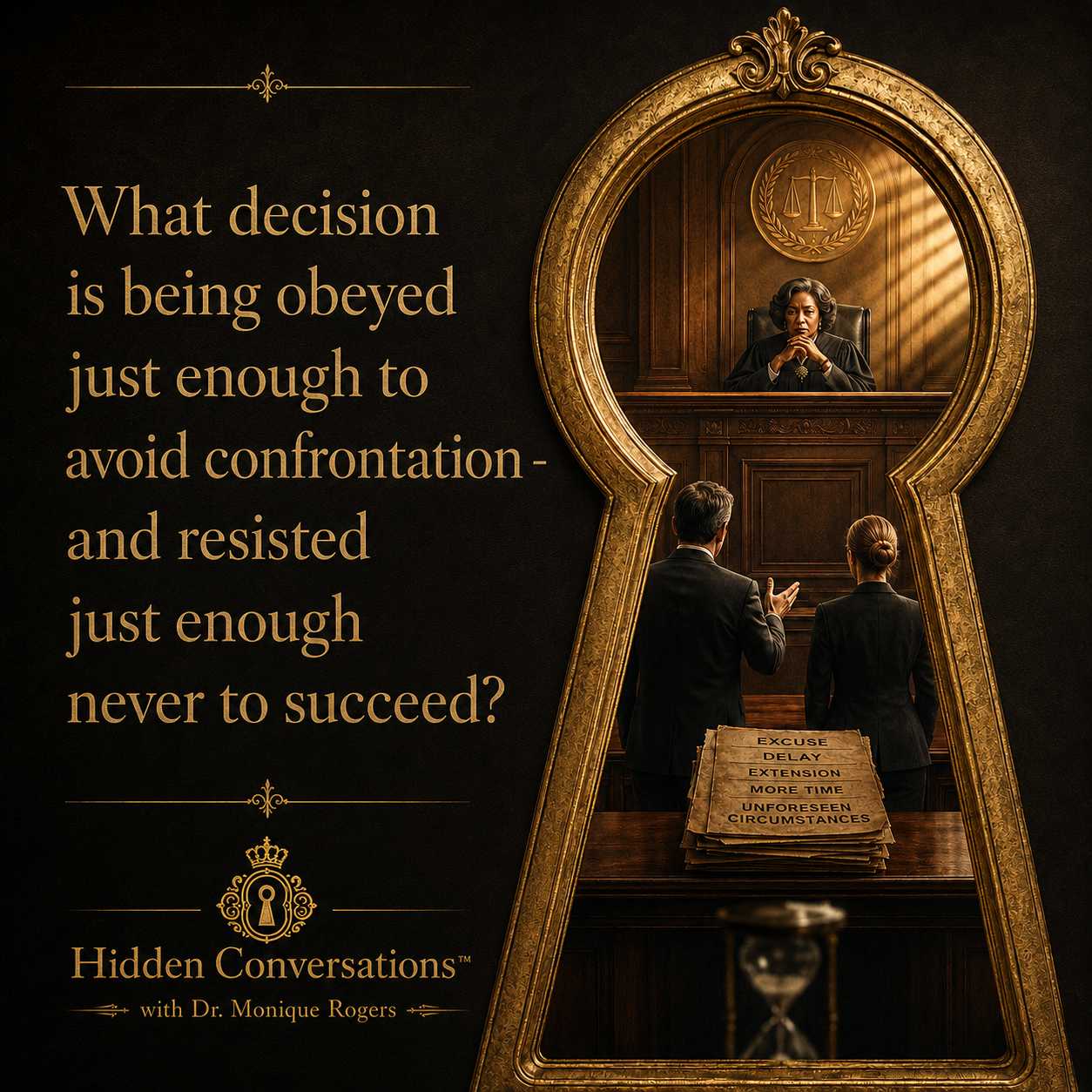
It is late in the afternoon. The case itself is not dramatic. Months earlier, a judge ordered one party to produce financial records. The records still have not arrived.
Counsel explains that the archive is incompatible with the current system. A key analyst has been unavailable. An additional review is necessary to protect confidential information. Each explanation is plausible. Each new deadline has passed.
THE JUDGE: Counsel, I have heard a reasonable explanation for every delay.
COUNSEL: Your Honor, my client is making every effort to comply.
THE JUDGE: Then help me understand why all of those reasonable explanations, taken together, have made my order meaningless.
THE JUDGE: Is your client complying - or simply waiting for compliance to become irrelevant?
The scene is fictional. The dynamic is not.
I recognize that courtroom because I have seen its organizational twin. A project is approved. Owners are assigned. No one refuses. Then every milestone encounters a perfectly defensible obstacle, and the initiative begins dying from causes no single person can be blamed for creating.
Quiet Sabotage: Delay Has a Constituency
We tend to imagine sabotage as an act committed by a villain: someone hides information, damages the work, or openly hopes the leader will fail. Quiet sabotage is rarely that tidy. It can be distributed across people who have not conspired but have reached the same private conclusion: this decision should not survive.
They do not have to coordinate. One person slows the data. Another postpones the training. Another identifies a risk but offers no path through it. No act is serious enough to prove intent. Together, however, the delays acquire a constituency. Time begins doing the work that no one feels safe doing aloud.
That is the hidden negotiation: Will we implement the decision, or will we outlast it?
The formal record shows dates, dependencies, and technical problems. The hidden record contains the concerns that were acknowledged but never answered, the reputational risk of challenging the sponsor, and the quiet belief that waiting is safer than dissent.
A judge looks at the whole docket, not merely the last excuse. Leaders must learn to read organizations the same way. The issue is not whether each delay can be defended. The issue is what the pattern is accomplishing.
A Confession from the Sponsor's Chair
I have been the decisive leader who believed the organization had discussed an issue long enough. I have felt the pressure to stop circling and move. Sometimes that decisiveness was exactly what the moment required.
But experience has made me more honest about the shadow side of certainty. When the person sponsoring the decision carries enough authority, confidence can fill the room so completely that everyone else's doubt loses oxygen. People may give us a yes because we have not created a psychologically safe place for a no.
Then, when implementation stalls, leaders can become indignant. We call the team resistant, unaccountable, or incapable of change. Sometimes they are. Sometimes we are looking at the invoice for a conversation we never truly allowed them to have.
Leadership is not entitled to commitment merely because it secured compliance. Commitment is built when people can influence the plan, challenge its assumptions, and revise it without forcing its sponsor to lose face.
What I Look for Now
Solving or reporting? Committed teams bring obstacles with options. Withdrawing teams bring obstacles as verdicts.
Disagreement answered or merely outlasted? A concern does not become resolved because the calendar moved beyond the meeting in which it was raised.
A revisable plan or a protected identity? If changing the plan would humiliate its sponsor, everyone has an incentive to let the project fail indirectly rather than correct it openly.
None of these questions permits leaders to dismiss real complexity. A delayed project may be exactly that: difficult work encountering difficult conditions. The discipline is to distinguish the obstacle that is slowing the work from the obstacle that has become socially useful because it protects people from having to state their true position.
MY RULING
Do not prosecute the delay before examining the conditions that made delay safer than dissent. Reopen the record. Ask what was never resolved. Invite the sentence no one was willing to say before the vote.
DR. MONIQUE'S HIDDEN QUESTION
What decision is being obeyed just enough to avoid confrontation and resisted just enough never to succeed?
Before your next status meeting, read the whole docket. Listen for what has been adjourned, not resolved.
Hidden Conversations(TM) is where I examine the exchanges beneath the official conversation, the places where power moves quietly, truth becomes expensive, and silence begins making decisions for us.
I hope this Hidden Peek gave language to something you have witnessed but could not quite name. Thank you for continuing to join me as my book, The Hidden Negotiation, makes its way toward publication.
I will meet you here again soon.
- Dr. Monique Rogers