August 9, 2026
When Did Accountability Become an Attack?
The quiet power of the victim narrative in rooms where no one wants to look cruel
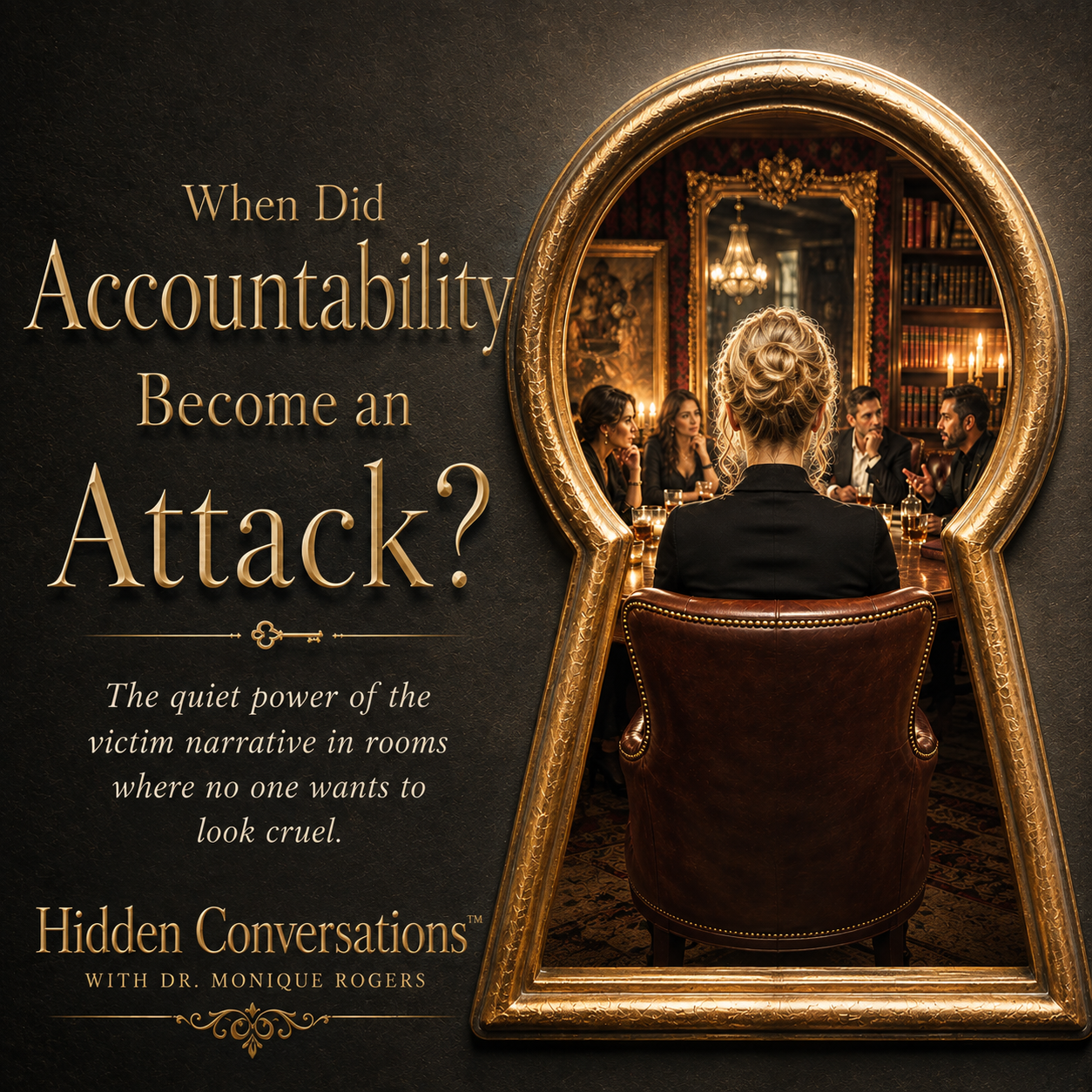
It happens so quickly that most people do not realize the conversation has changed.
A project is being reviewed. The numbers are disappointing. A deadline was unrealistic. Costs rose. Customers felt the consequences. Someone begins asking the questions that leadership is supposed to ask: What happened? Who knew? What should we do differently next time?
Then someone says, "I just want to make sure we recognize how hard my team worked."
The room softens.
Of course, the team worked hard. Of course, no one wants committed employees to feel unseen. And in that instant, the people evaluating the decision began reassuring the person whose decision was being evaluated.
No one announces that accountability has ended. No one votes to abandon the facts. The facts simply become socially expensive to discuss.
That is how power often moves in modern organizations. Not through a command, but through a feeling no one wants to be accused of causing.
The Conversation Beneath the Conversation
We are taught to look for power in authority, titles, budgets, and decision rights. But some of the most consequential forms of power appear in the emotional frame around a conversation. The person who controls that frame can quietly decide what everyone else is permitted to examine.
A leader does not have to disprove a concern if they can make the concern feel unkind. They do not have to defend the decision if they can redirect attention toward their sacrifice, their intentions, or the pain of being questioned. The original issue (the failed timeline, ignored warning, or poor judgment) remains on the table. Yet suddenly, touching it carries a reputational risk.
This is the victim narrative.
The victim narrative reframes scrutiny as injury. It turns evaluation into accusation, disagreement into disloyalty, and accountability into evidence that someone is being mistreated. Sometimes this response is unconscious. A threatened professional identity can make even capable leaders hear a review of their decision as a verdict on their worth. But whether intentional or instinctive, the effect on the room can be the same: everyone becomes more careful, and the truth becomes less complete.
The important distinction is not whether the emotion is real. Emotion can be completely genuine and still alter a conversation in ways that protect a person from necessary examination. Feeling hurt does not automatically make the question harmful. Feeling unappreciated does not make the data unfair. And working very hard does not guarantee that the underlying decision was sound.
Effort Is Not the Same as Outcome
This is where thoughtful leaders often become trapped. We know that people need recognition. We understand that major initiatives demand sacrifice. We also know that psychological safety matters. So when someone invokes the team's effort, our instinct is to protect the people who carried the work.
But there are two truths in the room, and leadership requires the capacity to hold both.
The team may have worked extraordinarily hard. The strategy may still have been flawed.
The leader may have had good intentions. The decision may still have created avoidable harm.
The feedback may feel painful. The feedback may still be necessary.
Mature accountability does not erase effort. It separates effort from evaluation. It allows us to honor the people who carried the weight while still examining why they were asked to carry so much of it in the first place.
In fact, refusing to examine a poor decision does not protect the team. It may condemn them to repeat the same unnecessary sacrifice under a new project name.
The Moral Advantage
The victim narrative gains influence because it creates a moral imbalance. One person appears to be defending loyalty, appreciation, fairness, or human dignity. Anyone who continues the critique risks appearing cold, punitive, or ungrateful.
Notice what has happened: the substantive question has not been answered. Instead, the social meaning of asking it has changed.
This is one of the hidden negotiations I explore in my forthcoming book, The Hidden Negotiation. Every room contains a visible agenda and an invisible one. The visible agenda may be operational performance. The invisible negotiation is about identity: Who gets to be seen as caring? Who will risk being seen as cruel? Whose discomfort will determine where the inquiry stops?
Once the room accepts the moral frame, the person who appears most wounded can become the person with the greatest control. Their pain sets the boundary. Their perception becomes the evidence. Their emotional response tells everyone else how far they are allowed to go.
That does not mean we should distrust emotion or dismiss legitimate experiences of harm. Quite the opposite. When every expression of harm is treated as manipulation, real victims are silenced, and leadership becomes dangerous. The skill is discernment: listening with care while remaining able to distinguish a report of harm from a redirection of accountability.
What Healthy Leadership Sounds Like
A powerful response does not argue with the emotion. It acknowledges the human concern and restores the analytical purpose of the conversation.
"I want to recognize the work and sacrifice that went into this project. That effort matters. We also need to understand the decisions that produced these outcomes so we do not ask the team to absorb the same costs again."
This language refuses the false choice between compassion and clarity. It protects dignity without surrendering inquiry.
Healthy leadership also watches for patterns. One defensive moment does not prove manipulation. Repeated emotional reframing, however, may reveal an accountability strategy: critique is consistently personalized, intent repeatedly replaces impact, and the same person becomes injured whenever outcomes are examined.
Patterns matter because isolated moments invite sympathy, while patterns reveal structure.
The Question We Rarely Ask
When a room suddenly becomes quiet, we often ask, "Did we hurt someone?"
That can be a deeply humane question.
But it should not be the only one.
We might also ask: What were we discussing immediately before the emotional shift? Which question remains unanswered? Who benefits if the inquiry ends here? What lesson will the organization lose if everyone moves on?
Sometimes the most revealing moment in a meeting is not the objection itself. It is the speed with which everyone abandons the question they were finally brave enough to ask.
Because accountability is not an attack. Done well, it is an act of stewardship. It protects the organization from repeating avoidable mistakes. It protects employees from carrying the burden of decisions they did not make. And it protects leaders from confusing being respected with never being questioned.
The most psychologically powerful person in the room is not always the one who speaks the loudest. Sometimes it is the one whose discomfort causes everyone else to stop speaking at all.
DR. MONIQUE'S HIDDEN QUESTION OF THE WEEK
Where have you mistaken someone's discomfort with accountability for proof that the accountability itself was wrong?
Carry the question into one meeting this week. Do not rush to answer it. Simply notice when the facts become harder to discuss after emotion enters the room and whether the conversation ever finds its way back.
Hidden Conversations(TM) is where we examine the conversations beneath the conversations, the subtle exchanges that shape power, silence truth, and determine what becomes possible in our organizations and our lives.
If this Hidden Peek gave language to something you have witnessed but could not quite name, subscribe and join me here as the book makes its way toward publication.
I will meet you here again soon.
- Dr. Monique Rogers